
General information only. It does not replace advice from a health professional. Do not self-medicate with antibiotics. For fever with a rash, a stiff neck, confusion or difficulty breathing, call emergency services.

What it is
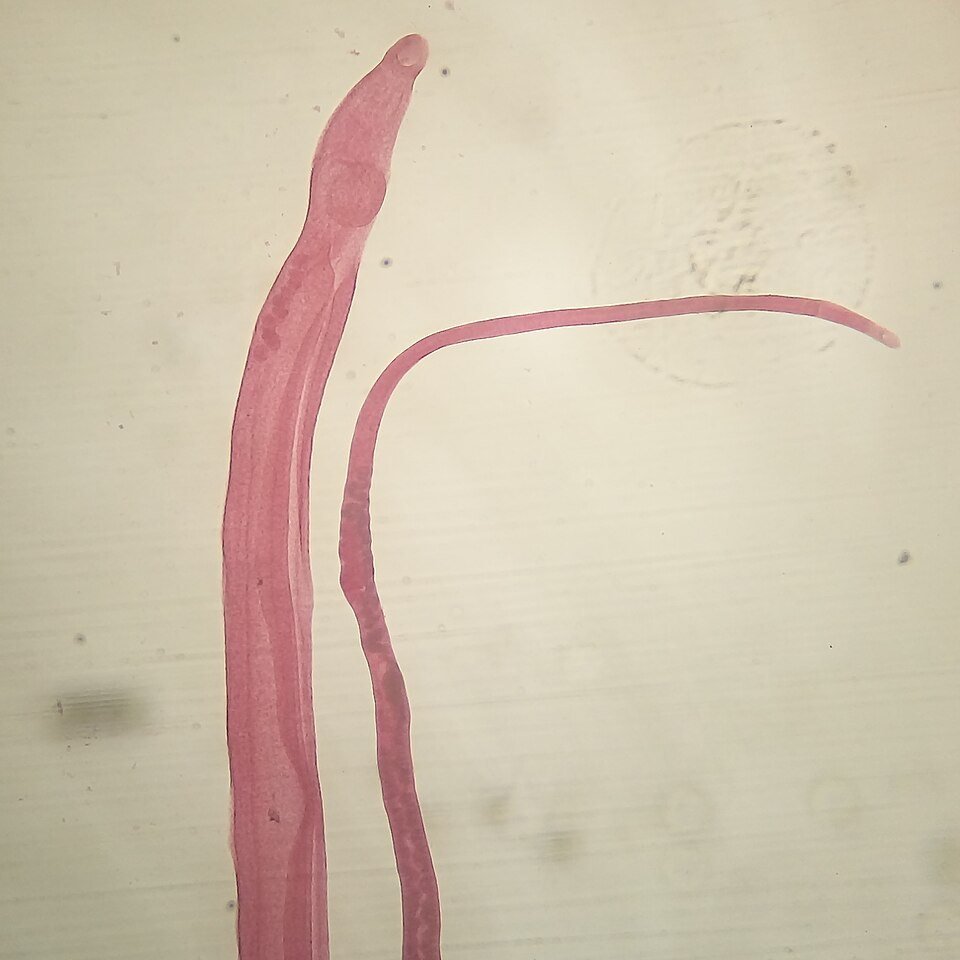
Schistosomes are trematodes (flukes), flatworms 1-2 cm long, but with a peculiarity: unlike other flukes, they have separate sexes. The thicker male has a longitudinal fold (the gynaecophoric canal) in which the long, thin female lies; the pair lives joined together for years inside the veins. The general biology of helminths is covered in fungi and parasites.
| Species | Where | Snail host | Location and disease | Egg |
|---|---|---|---|---|
| S. haematobium | Africa, Middle East; local outbreak in Corsica | Bulinus | Veins of the bladder and pelvis: urogenital | Terminal spine |
| S. mansoni | Africa, Middle East, Brazil, Venezuela, Caribbean | Biomphalaria | Mesenteric veins: intestinal and hepatic | Lateral spine |
| S. japonicum | China, Philippines, Indonesia | Oncomelania (amphibious) | Intestinal and hepatic; zoonosis (water buffalo, pigs, rodents) | Small, with a slight knob |
| S. mekongi | Mekong basin (Laos, Cambodia) | Neotricula | Intestinal and hepatic | Similar to S. japonicum |
| S. intercalatum and S. guineensis | Central and West Africa | Bulinus | Intestinal | Terminal spine |
There are also hybrids between S. haematobium and livestock species (S. bovis), such as the one that caused the Corsican outbreak.
The reservoir of S. haematobium and S. mansoni is mainly humans; S. japonicum is a zoonosis involving dozens of mammals, which makes it harder to control.
In numbers
- Worldwide: according to WHO Global Health Observatory data, in 2024 some 253.7 million people needed preventive treatment, 134.8 million of them school-age children; more than 90% live in Africa. Transmission has been reported in 79 countries, although preventive treatment is only needed in about 50 with moderate or high transmission.
- Mortality: estimates vary widely depending on the method, from tens of thousands to around 200,000 deaths a year, mainly from kidney failure, bleeding oesophageal varices and bladder cancer.
- Female genital schistosomiasis: WHO estimates that it affects tens of millions of women in Africa, many undiagnosed; it increases the risk of acquiring HIV.
- Europe: between 2013 and 2015 there was an outbreak of locally acquired urogenital schistosomiasis in Corsica (Cavu river), with more than a hundred cases among bathers, caused by an S. haematobium × S. bovis hybrid (Boissier and colleagues, Lancet Infectious Diseases, 2016).
- Spain and the UK: cases are imported, mainly in migrants from sub-Saharan Africa (some screening studies of recent arrivals from West Africa have found high prevalence) and in travellers who swam in African lakes and rivers; Lake Malawi is a classic example of infection in tourists. UK travel clinics see a steady stream of cases in returning travellers, gap-year students and volunteers.
How it spreads
- An infected person passes eggs in urine (S. haematobium) or stool (other species).
- If they reach fresh water, each egg releases a miracidium that swims to a specific snail.
- Inside the snail it multiplies for 4-6 weeks, and thousands of fork-tailed cercariae emerge, mostly around the middle of the day.
- Cercariae penetrate intact skin within minutes during bathing, fishing, washing clothes, irrigating fields or crossing a river.
- In the body they become schistosomula, pass through the lungs and liver, mature in the portal venous system, pair up and migrate to their final destination. They start laying eggs after 5-8 weeks.
It is not spread from person to person, nor by chlorinated swimming pool water or sea water. More in how infections spread and the One Health approach.
How it causes disease
The adult worms themselves cause little damage: they coat themselves in host proteins and evade immunity. The problem is the eggs. Each pair lays hundreds to thousands a day; roughly half pass out through the wall of the bladder or gut, but the rest become trapped in tissues (bladder wall, intestine, liver). An inflammatory granuloma forms around each egg and over the years leaves fibrosis:
- In the liver, periportal fibrosis (described as "pipe-stem") causes portal hypertension, an enlarged spleen and oesophageal varices that may bleed, often with preserved liver function.
- In the bladder and ureters: blood in the urine, calcification of the wall, urinary obstruction, kidney failure and squamous cell carcinoma of the bladder (S. haematobium is classified by IARC as a Group 1 carcinogen).
- In the genitals: lesions of the cervix, vagina and vulva (female genital schistosomiasis), pain, bleeding after sex, infertility; in men, blood in the semen and changes in the prostate and seminal vesicles.
- Eggs reaching the spinal cord or brain cause myelitis or brain lesions.
- Chronic infection in children causes anaemia, malnutrition and poorer school performance.
Diseases it causes
| Form | Who | Key features | More information |
|---|---|---|---|
| Cercarial dermatitis | After bathing | Itching and small bumps hours later; in Europe mostly caused by bird schistosomes ("swimmer's itch"), which cannot complete their cycle in humans | Benign, self-limiting |
| Acute schistosomiasis (Katayama fever) | Travellers without prior immunity, 2-8 weeks after exposure | Fever, urticaria, dry cough, headache, diarrhoea, marked eosinophilia | Traveller's fever |
| Urogenital (S. haematobium) | Children and adults in endemic areas, travellers | Terminal haematuria, stinging on passing urine, genital lesions, hydronephrosis, bladder cancer | Urinary tract infection (differential diagnosis) |
| Intestinal and hepatosplenic (S. mansoni, S. japonicum) | Chronic infection | Abdominal pain, bloody diarrhoea, anaemia; years later, portal hypertension and gastrointestinal bleeding | Gastroenteritis and diarrhoea |
| Neuroschistosomiasis | Any stage | Transverse myelitis with low back pain and leg weakness; seizures | Brain abscess and CNS infections |
| Schistosomiasis in pregnancy | Women from endemic areas | Anaemia, low birth weight | Infections in pregnancy |
Colonisation versus infection
There is no healthy carrier state: viable eggs or circulating antigens indicate living worms, even without symptoms, and are treated. Positive serology, by contrast, only indicates contact: it may persist for years after cure and cannot distinguish active from past infection, so it is interpreted together with the exposure history and other tests.
Microbiological diagnosis
| Test | Sample and technique | Performance and thresholds | How to interpret it |
|---|---|---|---|
| Urine microscopy | Urine collected between 10 am and 2 pm, ideally the last part of the stream, after exercise; 10 mL filtration | Intensity (WHO): light < 50 eggs/10 mL; heavy ≥ 50 eggs/10 mL | Eggs with a terminal spine = S. haematobium; low sensitivity in light infections and in travellers |
| Stool microscopy (Kato-Katz and concentration) (parasites in stool) | Several samples on different days | Intensity (WHO): light 1-99, moderate 100-399, heavy ≥ 400 eggs per gram | Lateral spine = S. mansoni; insensitive at low burdens |
| Serology | Blood, at least 6-12 weeks after the last exposure | Very sensitive in travellers and migrants | Indicates exposure; cannot tell cured from active; may cross-react with other helminths |
| Circulating cathodic antigen (CCA) | Rapid urine strip | Good sensitivity for S. mansoni; lower for S. haematobium | Indicates living worms; used in control programmes. See rapid tests |
| Circulating anodic antigen (CAA) | Serum or urine, reference laboratory | Very sensitive, detects light infections | Useful to confirm cure |
| PCR | Stool, urine, serum, biopsies | More sensitive than microscopy | Increasingly used in tropical medicine centres |
| Biopsy (histopathology) | Rectum, bladder (cystoscopy), cervix | Detects eggs trapped in tissue | Useful when urine and stool are negative |
| Ultrasound (imaging) | Abdomen and urinary tract | Periportal fibrosis, thickened bladder wall, hydronephrosis | Assesses organ damage and its regression |
Eosinophilia is a very common clue, especially in the acute phase: see white cells and differential count. The urine may contain blood and white cells without bacteria.
Teaching example (invented report): "Midday urine, 10 mL filtration: 12 viable Schistosoma haematobium eggs seen." Interpretation: active urogenital schistosomiasis of light intensity; treatment with praziquantel and follow-up at 4-8 weeks.
Resistance
Praziquantel has been the only drug in mass use for more than 40 years, and lower cure rates have been described in some areas, along with strains showing reduced sensitivity in the laboratory, but there is no widespread clinical resistance. Its main limitation is that it does not kill young forms (schistosomula), which is why the dose is repeated after recent exposure.
Treatment
Antiparasitic drugs are described in antiparasitic drugs: albendazole, ivermectin and others. Do not self-medicate: the dose and timing are decided by the doctor.
| Situation | First choice | Comments |
|---|---|---|
| S. haematobium, S. mansoni, S. intercalatum | Praziquantel 40 mg/kg as a single dose or split into two doses on the same day | In travellers and migrants many centres repeat it after 6-12 weeks to clear worms that were immature |
| S. japonicum, S. mekongi | Praziquantel 60 mg/kg split into 2-3 doses on the same day | — |
| Katayama fever | Corticosteroids for the inflammatory reaction; praziquantel at the same time and repeated 6-12 weeks later | Praziquantel in the acute phase may temporarily worsen symptoms |
| Neuroschistosomiasis | Praziquantel + corticosteroids | Urgent specialist care |
| Children aged 3 months to 6 years (programmes in endemic areas) | Arpraziquantel, 150 mg dispersible tablets | Positive scientific opinion from the EMA (EU-M4all procedure, December 2023), for use outside the EU |
| Pregnancy and breastfeeding | WHO allows praziquantel after the first trimester in endemic areas | Outside those areas, decisions are individualised |
| Chronic complications | Endoscopic treatment of varices, management of portal hypertension, urological surgery | Many early lesions regress after treatment |
The 2022 WHO guideline on control and elimination of schistosomiasis recommends annual preventive treatment with praziquantel for everyone aged 2 years and over in communities with prevalence of 10% or more (previously the focus was on schoolchildren), extended to adults, pregnant women after the first trimester and breastfeeding women. In Spain, access to praziquantel for human use may require the special-situations (foreign medicines) route: check the AEMPS CIMA database or the hospital pharmacy. In the UK it is generally available through travel and tropical medicine services.
Prevention
- Avoid contact with fresh water (bathing, swimming, wading, washing) in endemic areas, especially lakes and rivers in Africa. Well-maintained chlorinated pools and the sea are safe. Towelling off vigorously after contact is not reliable protection. More advice in healthy travel.
- Boil or filter bathing and washing water if it comes from endemic rivers or lakes.
- Post-travel check: anyone who has been in fresh water in an endemic area should seek advice and have serology from 12 weeks onwards, even without symptoms.
- Screening of migrants from sub-Saharan Africa: serology and urine and stool tests, especially if there is eosinophilia or haematuria.
- Public health: mass preventive treatment, safe water, sanitation and hygiene, snail control and education. WHO aims to eliminate it as a public health problem in all endemic countries by 2030.
- Vaccines: candidates are in clinical trials, but none has been approved.
Warning signs: go to the emergency department or call 112 in Europe, or your local emergency number, if days or weeks after swimming in fresh water in an endemic area you develop a high fever (and think of malaria too, which is the emergency to rule out first), or if at any time you have vomiting blood or black stools, weakness or loss of strength in the legs with low back pain or inability to pass urine, or urine with a lot of blood and clots.
Curiosities and brief history
- In 1851, the German doctor Theodor Bilharz, working in Cairo, found the worms in the veins at a post-mortem examination: hence the name "bilharzia".
- Calcified eggs have been found in Egyptian mummies more than 3,000 years old, making it one of the best-documented parasitic diseases of antiquity.
- Dams and irrigation schemes (such as the Aswan dam in Egypt or the Diama dam in Senegal) multiplied snails and transmission in the 20th century: a classic example of how environmental change shapes infection.
- Blood in the urine of boys was so common in parts of Africa that it was regarded as a kind of normal "male menstruation".
Myths and facts
- "A big, clean lake is safe." False: cercariae are invisible, and the crystal-clear water of Lake Malawi is a well-known source of infection.
- "A quick dip won't do any harm." False: a few minutes of water contact is enough.
- "If I have no symptoms after my trip, I'm not infected." False: many travellers have no symptoms and the infection can cause problems years later; that is why serology is recommended.
- "One dose of praziquantel is always enough." Not always: in recent infections it is usually repeated because the drug does not kill immature worms.
- "It's a disease that can't reach Europe." False: the Corsican outbreak showed it can be transmitted if suitable snails and infected people are present.
Sources
- World Health Organization. WHO guideline on control and elimination of human schistosomiasis. Geneva: WHO; 2022.
- World Health Organization. Global Health Observatory: schistosomiasis, preventive chemotherapy data for 2024. Geneva: WHO; 2025.
- World Health Organization. Schistosomiasis and soil-transmitted helminthiases: progress report, 2024. Wkly Epidemiol Rec. 2025.
- European Medicines Agency. New treatment for young children with parasitic disease schistosomiasis (arpraziquantel). 2023.
- Centers for Disease Control and Prevention. CDC Yellow Book 2026: Health Information for International Travel. Schistosomiasis chapter. Oxford University Press; 2025.
- Boissier J, et al. Outbreak of urogenital schistosomiasis in Corsica (France): an epidemiological case study. Lancet Infect Dis. 2016;16(8):971-9. doi:10.1016/s1473-3099(16)00175-4
- Lo NC, et al. Review of 2022 WHO guidelines on the control and elimination of schistosomiasis. Lancet Infect Dis. 2022;22(11):e327-e335. doi:10.1016/s1473-3099(22)00221-3
- McManus DP, et al. Schistosomiasis. Nat Rev Dis Primers. 2018;4(1):13. doi:10.1038/s41572-018-0013-8
- Colley DG, et al. Human schistosomiasis. Lancet. 2014;383(9936):2253-64. doi:10.1016/s0140-6736(13)61949-2
- World Health Organization. Schistosomiasis: fact sheet.
Sources reviewed and updated in November 2026.
History · Medicapedia
The history of this condition
How it was described, who studied it and how its treatment has changed over the centuries, on Medicapedia, our sister encyclopedia of the history of medicine.