
General information only. It does not replace advice from a health professional. Do not self-medicate with antibiotics. For fever with a rash, a stiff neck, confusion or difficulty breathing, call emergency services.
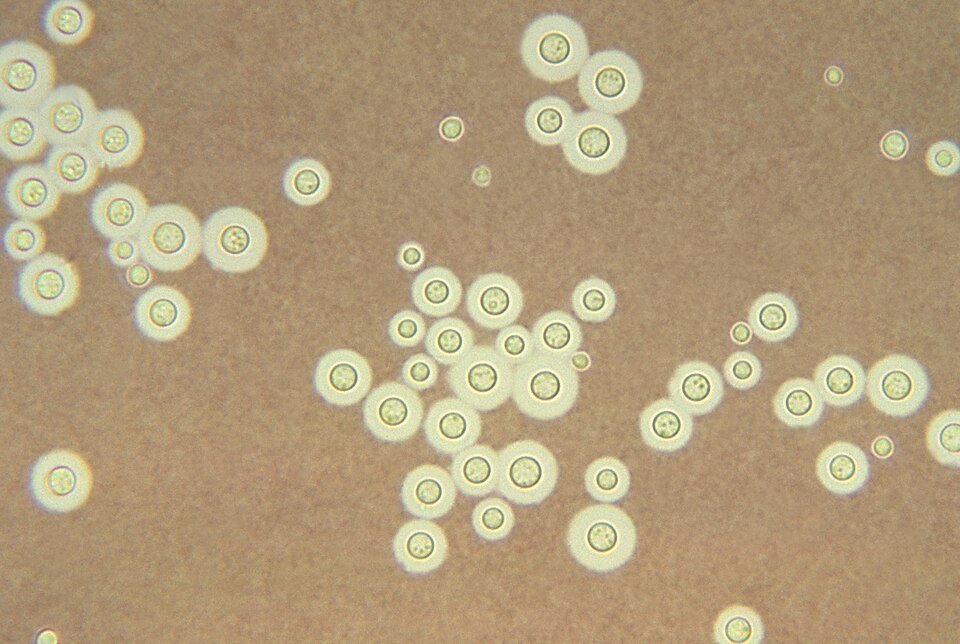

What it is
Cryptococcus is a genus of yeast-like fungi (basidiomycetes) that reproduce by budding. Its most striking features:
- Shape: round yeasts 4-10 µm across surrounded by a polysaccharide capsule (glucuronoxylomannan) that can double their size. With India ink the capsule appears as a clear halo against a black background, a classic image in microbiology (see Gram stain and microscopy).
- Species: the C. neoformans complex (formerly the grubii and neoformans varieties) causes the vast majority of cases worldwide, in Spain and in the UK; the C. gattii complex (several species, such as C. gattii sensu stricto and C. deuterogattii) more often affects people with no apparent immunosuppression.
- Where it lives: C. neoformans in soil and dust containing dried pigeon droppings, dovecotes, lofts and tree hollows. Pigeons do not become ill: the fungus does not grow well at their body temperature (about 41 °C). C. gattii in eucalyptus and other trees; from 1999 it caused an outbreak on Vancouver Island (Canada) that spread to the north-western United States.
For the basics about fungi, see the biology of fungi and parasites.
Facts and figures
- According to an estimate published in The Lancet Infectious Diseases (Rajasingham and colleagues, 2022), in 2020 there were about 152,000 cases of cryptococcal meningitis in people with HIV worldwide and 112,000 deaths, around 19% of all AIDS-related deaths. Most occurred in sub-Saharan Africa.
- Denning's global estimate (Lancet Infect Dis, 2024) puts the annual figure at about 194,000 cases of cryptococcal meningitis and 147,000 deaths (around 76%), including people without HIV.
- The WHO placed C. neoformans in the critical priority group of its 2022 fungal priority pathogens list, and C. gattii in the medium priority group.
- In Spain, the UK and the rest of western Europe, cryptococcosis is now uncommon thanks to antiretroviral therapy, but it still occurs in people with late HIV diagnosis, solid organ transplant recipients (it is the third most common invasive fungal infection in them, after Candida and Aspergillus), people with haematological cancer, cirrhosis, sarcoidosis or on steroids and other immunosuppressants. It is not notifiable.
How it spreads
By inhaling dried yeasts or spores from the environment. It does not spread from person to person (except in very rare cases via a transplanted organ), nor from birds or pets to people through direct contact. Many people are infected in childhood without symptoms: the fungus can remain dormant in the lung lymph nodes and reactivate years later if immunity falls.
How it causes disease
Defence against Cryptococcus depends on cell-mediated immunity (CD4 T cells and macrophages activated by interferon gamma; see the immune system against infection). That is why those with low CD4 counts are most at risk. Its virulence factors:
- Capsule: prevents phagocytosis and "floods" blood and cerebrospinal fluid with antigen, which blunts the immune response and blocks fluid reabsorption, raising intracranial pressure.
- Melanin (produced by the enzyme laccase from catecholamines, abundant in the brain): protects against free radicals.
- Urease and other enzymes that help it cross the blood-brain barrier.
- "Titan" cells: giant yeasts that form in the lung and cannot be phagocytosed.
The fungus has a particular tropism for the central nervous system. Raised intracranial pressure is the main cause of early death, blindness and deafness.
Diseases it causes
| Disease | Who | Key features | More information |
|---|---|---|---|
| Cryptococcal meningoencephalitis | HIV with CD4 < 100/µL, transplants, steroids; C. gattii also in immunocompetent people | Progressive headache over 1-4 weeks, fever, vomiting, blurred or double vision, confusion; often no neck stiffness | Meningitis |
| Pulmonary cryptococcosis | Immunocompetent and immunosuppressed | From incidental nodules (mistaken for cancer) to pneumonia and respiratory failure | Imaging |
| Asymptomatic antigenaemia | Advanced HIV | Positive blood antigen without symptoms; precedes meningitis by weeks or months | Advanced HIV |
| Cutaneous and disseminated cryptococcosis | Severe immunosuppression | Umbilicated papules resembling molluscum contagiosum, ulcers; prostate, bone and eye involvement | Opportunistic infections |
| Cryptococcomas | Mainly C. gattii | Masses in lung or brain; longer treatment | — |
| Immune reconstitution inflammatory syndrome (IRIS) | After starting antiretroviral therapy | Paradoxical worsening with a culture already negative | Antiretroviral therapy |
Colonisation versus infection
A positive respiratory culture for Cryptococcus is almost never a mere contaminant: it requires disseminated disease to be ruled out, especially in immunosuppressed patients. Anyone with pulmonary cryptococcosis or positive blood antigen and risk factors should have a lumbar puncture, even without neurological symptoms, because meningeal involvement changes treatment.
Microbiological diagnosis
Lumbar puncture is the key test, and opening pressure must always be measured. CSF values are discussed in cerebrospinal fluid values.
| Test | Specimen | Interpretation | Performance |
|---|---|---|---|
| Cryptococcal antigen (CrAg) lateral flow assay | Serum, plasma, fingerprick blood, CSF | Positive = infection; the titre reflects fungal burden (high titres, worse prognosis) | Sensitivity and specificity > 99% in CSF; see rapid tests |
| India ink | CSF | Yeasts with a capsular halo | Sensitivity around 80% in HIV, lower in other patients |
| Culture | CSF, blood, sputum, biopsy | Mucoid colonies in 2-7 days; allows susceptibility testing | Gold standard; quantitative counts track response; see culture |
| Opening pressure | Lumbar puncture lying on the side | Normal < 20 cm H₂O; ≥ 25 cm H₂O = raised pressure requiring drainage | Measuring it is mandatory |
| CSF chemistry and cells | CSF | Low glucose, high protein, lymphocytes | In advanced HIV it may be near normal despite infection |
| PCR (meningitis panels) | CSF | Detects C. neoformans/gattii DNA | Can give false negatives; does not replace the antigen test; see PCR |
| Histology | Lung, skin | Encapsulated yeasts (mucicarmine stain) | See biopsy |
| Blood cultures | Blood | Positive in disseminated disease | See blood cultures |
Antigen screening: the WHO recommends blood CrAg testing for everyone with HIV and a CD4 count < 100/µL (and considering it below 200/µL). If positive without meningitis, high-dose pre-emptive fluconazole is given. See HIV tests, viral load and CD4.
Resistance
- Cryptococcus is intrinsically resistant to echinocandins (caspofungin, micafungin, anidulafungin), which are useless against it.
- Flucytosine monotherapy rapidly selects resistance, so it is always combined.
- Rising fluconazole MICs and heteroresistance (resistant subpopulations) have been described, particularly in Africa and in relapses after fluconazole alone. Resistance is uncommon in Spain. See susceptibility testing and MIC.
Treatment
The current reference is the global cryptococcosis guideline from the ECMM and ISHAM with the ASM (Lancet Infect Dis, 2024), endorsed by more than 70 societies, and for people with HIV the 2022 WHO guideline. The drugs are described under antifungals. Decisions are made by the medical team.
| Phase | Preferred regimen | Alternatives | Duration |
|---|---|---|---|
| Induction (meningitis, HIV, WHO 2022) | Single dose of liposomal amphotericin B 10 mg/kg + flucytosine + fluconazole 1,200 mg/day | Amphotericin B deoxycholate + flucytosine for 1 week, then fluconazole; or fluconazole + flucytosine | Flucytosine and fluconazole for 14 days |
| Induction (well-resourced settings, 2024 global guideline) | Liposomal amphotericin B (3-4 mg/kg/day) + flucytosine | Single-dose regimen; liposomal amphotericin alone or with fluconazole if flucytosine is unavailable | 2 weeks in HIV; at least 4 weeks in other patients |
| Consolidation | Fluconazole 400-800 mg/day | — | 8 weeks |
| Maintenance | Fluconazole 200 mg/day | — | At least 1 year; in HIV, until antiretroviral therapy raises CD4 and suppresses viral load |
| Mild lung disease or antigenaemia without meningitis | Fluconazole (400-800 mg/day; high doses for antigenaemia) | — | 6-12 months |
Key points:
- The AMBITION-cm trial (N Engl J Med, 2022), in five African countries, showed that a single high dose of liposomal amphotericin with flucytosine and fluconazole was non-inferior to the standard one-week regimen (10-week mortality 24.8% vs 28.7%) with far fewer side effects (anaemia, potassium and kidney problems).
- Raised intracranial pressure is treated with repeated therapeutic lumbar punctures (for example daily while pressure remains high). Steroids, acetazolamide and mannitol do not help: in the CryptoDex trial (N Engl J Med, 2016), dexamethasone worsened outcomes.
- When to start antiretroviral therapy: wait 4-6 weeks after starting antifungals. In the COAT trial (N Engl J Med, 2014), starting in the first or second week increased mortality. See antiretroviral therapy and the HIV treatment guide.
- Flucytosine is essential, but availability is limited in many countries; in Spain it may need special import procedures. Blood counts and levels need monitoring.
- In transplant recipients, immunosuppression is reduced cautiously, because IRIS can also occur.
Prevention
- Diagnosing HIV early and starting antiretroviral therapy is the best prevention (see HIV infection).
- Antigen screening in people with HIV and low CD4 counts, with pre-emptive fluconazole if positive. It is part of the WHO package of care for advanced HIV disease.
- Severely immunosuppressed people should avoid cleaning dovecotes, lofts or areas with accumulated bird droppings.
- Universal primary fluconazole prophylaxis is not recommended in Europe. There is no vaccine.
Warning signs: if you live with HIV (especially if recently diagnosed or not on treatment), have a transplant or take immunosuppressants, seek help urgently (call 112 in Europe, or your local emergency number) for a new, persistent headache, especially with fever, vomiting, blurred or double vision, confusion, drowsiness or seizures. Cryptococcal meningitis can begin insidiously and without neck stiffness.
Curiosities and brief history
- In 1894, the Italian Francesco Sanfelice isolated the fungus from peach juice, and that same year the Germans Otto Busse and Abraham Buschke described the first human case (a bone lesion), so it became known as "Busse-Buschke disease".
- The link with pigeons was described in the 1950s (Emmons). Pigeons carry the fungus without becoming ill.
- The C. gattii outbreak on Vancouver Island, from 1999, affected people, dogs, cats and even porpoises, showing how a tropical fungus could establish itself in a temperate climate.
- The melanin of Cryptococcus protects it against ionising radiation, and it has been studied in the laboratory as a model of fungi able to grow in radioactive environments.
Myths and facts
- "Pigeons spread meningitis." Not directly: the risk comes from inhaling dust from dried droppings and is only relevant for severely immunosuppressed people.
- "Cryptococcosis spreads between people." False.
- "If the cerebrospinal fluid looks almost normal, it isn't meningitis." False: in advanced HIV, cryptococcal meningitis can occur with few cells, which is why the antigen is always tested.
- "Steroids reduce brain inflammation and help." Not in cryptococcal meningitis: in trials they increased disability and did not reduce mortality.
Sources
- Chang CC, et al. Global guideline for the diagnosis and management of cryptococcosis: an initiative of the ECMM and ISHAM in cooperation with the ASM. Lancet Infect Dis. 2024;24:e495-512. doi:10.1016/s1473-3099(23)00731-4
- World Health Organization. Guidelines for diagnosing, preventing and managing cryptococcal disease among adults, adolescents and children living with HIV. 2022.
- Denning DW. Global incidence and mortality of severe fungal disease. Lancet Infect Dis. 2024;24:e428-38.
- Rajasingham R, et al. The global burden of HIV-associated cryptococcal infection in adults in 2020: a modelling analysis. Lancet Infect Dis. 2022;22:1748-55. doi:10.1016/s1473-3099(22)00499-6
- Jarvis JN, et al. Single-dose liposomal amphotericin B treatment for cryptococcal meningitis (AMBITION-cm). N Engl J Med. 2022;386:1109-20.
- Boulware DR, et al. Timing of antiretroviral therapy after diagnosis of cryptococcal meningitis (COAT). N Engl J Med. 2014;370:2487-98.
- Beardsley J, et al. Adjunctive dexamethasone in HIV-associated cryptococcal meningitis (CryptoDex). N Engl J Med. 2016;374:542-54.
- NIH ClinicalInfo. Guidelines for the prevention and treatment of opportunistic infections in adults and adolescents with HIV: cryptococcosis. Current version.
- World Health Organization. WHO fungal priority pathogens list. 2022.
Sources reviewed and updated in November 2026.
History · Medicapedia
The history of this condition
How it was described, who studied it and how its treatment has changed over the centuries, on Medicapedia, our sister encyclopedia of the history of medicine.